Kosher Phones Explained: Every Kind, and How to Choose
A kosher phone is a phone set up to keep out what a Torah home does not want. The first ones, sold in Israel in 2005, had no internet, texting, video or camera. Today there are four kinds: basic phones, basic phones with a few apps, smartphones built to be kosher, and protected iPhones. Choose by what the person must keep, what your school accepts, and who can undo it.
What "kosher phone" means
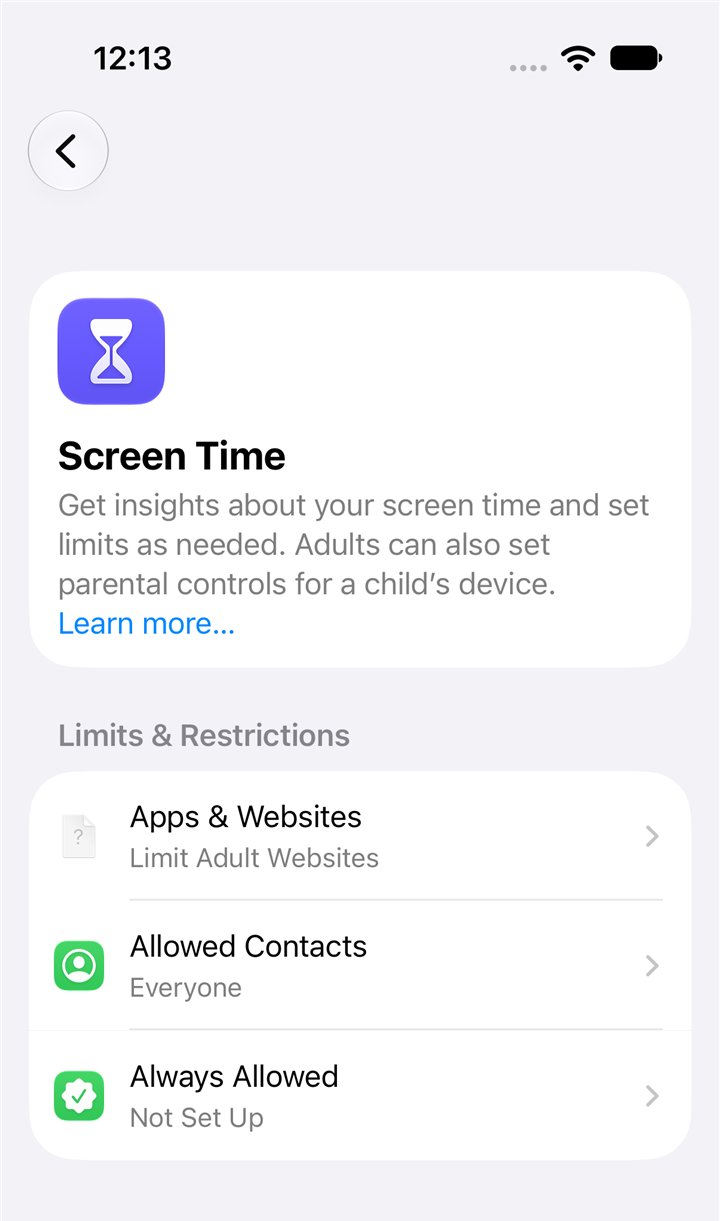
A kosher phone is not kosher because of its maker or its box. Where a phone carries an approval, it comes from a rabbinical body or your community, and the approval that matters is the one your rav and your school accept. It is a phone whose reach has been narrowed to fit the standards of a Torah home: no open internet, and sometimes no texting, video or camera, or only the few of those a family chooses to keep. The name borrows the idea of kashrus (something ordinary, checked so it fits) and applies it to the device in your pocket.
Three things make the idea confusing, and it helps to name them up front:
- There is no single standard. What one community, school or rav accepts, another may not.
- The word covers very different devices, from a phone that only makes calls to a full smartphone with carefully chosen apps.
- In Israel it also means a phone line: special numbers on which the carrier itself blocks certain services, under rabbinic oversight. In America it almost always means the device and how it is set up.
Where the kosher phone came from
The kosher phone began as an answer to a new problem. In the early 2000s, mobile phones were bringing the outside world, and later the internet, into homes that had kept it out.
Israel, 2004 to 2005: the first kosher phones
In late 2004, according to the Associated Press, "a special rabbinical panel was formed to study how to bridge the need for cellular phones and ultra-Orthodox codes." By March 2005 the first kosher phones were on sale in Israel, and, as Engadget reported at the time, "all Internet access, SMS text messaging, video, and voice mail have been disabled on the phones." They sold quickly: "By summer, more than 20,000 kosher phones were sold." The early phones did calls and little else. "There's no text messaging, no Internet access, no video options, no camera," the Associated Press wrote in 2006.
Israel today: a kosher line, not just a kosher phone
In Israel, "kosher" became a property of the phone line. A Jerusalem Post report in February 2026 quoted an Israeli carrier: "The authority to determine the blocking of lines known as 'Kosher Lines' is vested in the Rabbinical Committee for Communications Affairs." We found no official count of such lines. In 2022, Israel's Communications Minister said the rules on kosher lines had harmed about half a million customers in the Haredi public (Globes, in Hebrew). Kosher phones there come, as the Times of Israel put it, "stripped of features such as web browsers and messaging apps", and they are "often required in order to engage in basic activities such as enrolling children in school." In July 2024 the Knesset passed, 60 to 53, an amendment that "allows carriers to lock in place subscriptions for users of so-called kosher phones."
America, 2012: Citi Field
On May 20, 2012, "tens of thousands of ultra-Orthodox Jewish men" filled Citi Field, the New York Mets' stadium, for a gathering on the dangers of the internet, with the overflow crowd in the Arthur Ashe Stadium next door. A spokesman for the organizers said that "the rally's purpose was not to ban the Internet but to learn how to harness it."
America, the schools
In America, the push has come most often through schools. In 2015, JTA reported that the Hasidic village of Kiryas Joel tied yeshiva enrollment to parents' phone rules. Men could use a smartphone only if it was essential to their business, and then only with approved protection on it; women were to use "only a basic cellphone." The same form let families choose a level of restriction, such as "email only, basic apps", an early sign that kosher does not have to mean all or nothing.
In 2022, a group of Modern Orthodox yeshiva high schools in the United States and Canada announced together that "all of our schools are committed to making our classrooms and most of our school days smartphone free." And the wider world has moved the same way: in May 2025 New York State announced it would restrict smartphones in public schools for the whole school day, while "students would still be authorized to have access to simple cellphones without internet capability." By July 2026, Education Week counted at least 39 states and the District of Columbia requiring schools to ban or restrict students' phones.
The four kinds of kosher phone today
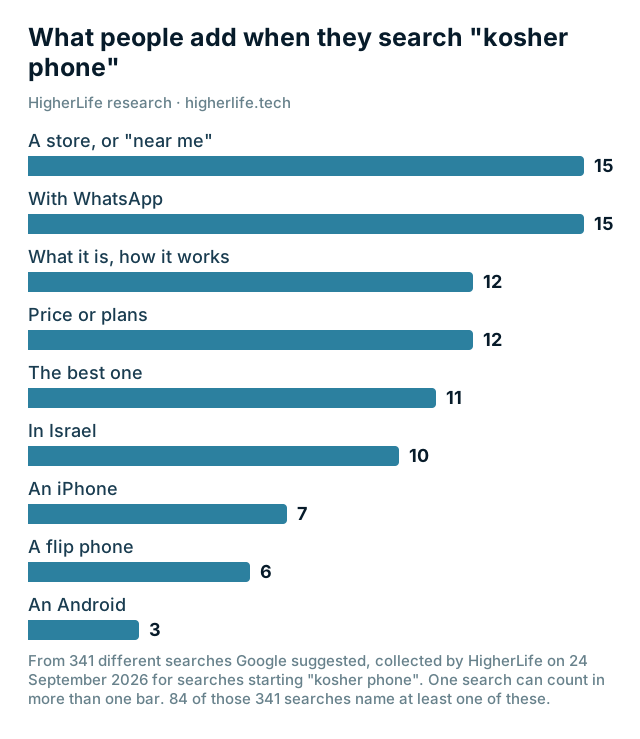
Every kosher phone sold or set up today fits one of four kinds. They differ in what they keep, what they keep out, and, most of all, in who can undo them.
| Talk-and-text basic phone | Basic phone with chosen apps | Smartphone built to be kosher | Protected iPhone | |
|---|---|---|---|---|
| What it is | A flip or bar phone that calls and, usually, texts | A basic phone with a short list of apps added | An Android phone sold with a locked-down system | An ordinary iPhone, set up and kept to a standard |
| Internet | None | Only through the chosen apps | Only what the system allows | Only what the chosen level allows |
| No | Sometimes | Often, as an option | Can be kept | |
| Maps and rides | No | Sometimes | Often | Can be kept |
| Keyboard and camera | Keypad, basic camera or none | Keypad or small screen | Full touch screen, good camera | Full touch screen, iPhone camera |
| Keep the phone you own? | No, a new device | No, a new device | Usually a new device | Yes, if it is an iPhone |
| Who can undo it | Nothing to undo | The seller's system decides | The seller's system decides | Depends on who set it up (see our kosher iPhone guide) |
| Best for | Anyone who needs only calls, and what some schools require | People who need one or two apps | People who want Android and a system made for this | People who need a real smartphone, or already own an iPhone |
What you keep and what you give up
Every kind is a trade. The honest way to choose is to look at both sides, in the words of the people who live with them.
What people love about basic phones
The strongest argument for a basic phone is calm. "I feel am much calmer with a flip phone, don't feel like I need to check if I missed anything anymore," one woman wrote. Another started her own search with a sentence many people could have written: "I waste so much time on my phone."
What people find hard
The complaints about basic phones are practical and they repeat: "The screen is very very small, keyboard is very difficult to use," wrote one woman who had just switched. Another asked: "Also which kosher phone is easiest for texting? I can't get used to the T9 flip phone." Battery life, a weak camera and no maps come up again and again, and so does the second phone people end up carrying for work or for WhatsApp.
The real question underneath
When we read 319 questions and comments from 96 forum and news pages, from 2010 to 2026, one worry sat under many of them. In our words: I want out of the open smartphone, but I am afraid of losing the few things I really use, and of spending money on a phone I will hate. The four kinds above are four different answers to that sentence.
How to choose: six questions in order
Answer these in order. The first question that decides it, decides it.
- Does your school, yeshiva, seminary or community require a specific kind of phone? If yes, that is your answer. Ask them exactly what they accept before you buy anything.
- Does the person need anything beyond calls and texts? Go through the list: WhatsApp, maps, rides, the bank's sign-in code, email, the camera, work apps. If the answer is truly no, a talk-and-text phone is the simplest and calmest choice.
- Do they already own an iPhone? If yes, a protected iPhone keeps the phone, the number and the photos, and costs no new device.
- Who will keep the key? A standard that the person carrying the phone can switch off will be switched off on a hard day. Choose a kind where someone else holds the key (for a child, a parent), and ask any seller or service exactly who can change it.
- Will they hate the device? Small screens, slow typing and weak batteries are the top reasons people give up. Hold the phone before you choose it.
- What does a whole year cost? Add it up with the worksheet below, including the second phone people end up buying when the first one does not fit.
The true cost of a year
People are often surprised by the cost of a kosher phone, and just as often by how hard it is to compare. The way to compare fairly is to add up the same five lines for every option:
| Line | What to include |
|---|---|
| 1. The device | The price of a new phone, or nothing if you keep the one you own |
| 2. Setup | Any setup or activation fee |
| 3. The service | The monthly fee times twelve, or the yearly fee |
| 4. The phone plan | Your carrier's plan, which you pay for any phone |
| 5. The hidden line | A second phone for work or WhatsApp, a navigation device, a replacement for a phone you could not live with |
Line 5 is the one most people forget, and it can be the largest.
What "certified" and "approved" mean
You will see kosher phones described as certified, approved or stamped. These words mean different things in different places:
- In Israel, a kosher line is overseen by the Rabbinical Committee for Communications Affairs, which decides what those lines block.
- In America, there is no single national body. Schools, communities and local rabbanim each decide what they accept, and a seller's own stamp is not the same as your community's approval.
- For your family, the approval that matters is the one from your rav and your school. Ask them directly what they accept, and bring the answer with you when you choose.
Questions people ask
What is a kosher phone?
A phone set up to keep out what a Torah home does not want. The first kosher phones, sold in Israel in 2005, had no internet, texting, video or camera. Today the word covers basic phones, basic phones with a few apps, smartphones built to be kosher, and protected iPhones.
How does a kosher phone work?
It depends on the kind. A basic phone simply lacks the features. A smartphone built to be kosher runs a locked-down system. In Israel, the phone line itself is kosher, and the carrier blocks services under rabbinic oversight. A protected iPhone is set up so that what it can reach matches a chosen standard.
Do kosher phones have internet?
Traditional kosher phones have none. Newer kinds may reach the internet only through chosen apps, or only within a chosen standard. Ask exactly what a phone can reach before you buy it.
Can a kosher phone have WhatsApp?
Some can and some cannot, and families disagree about whether it should. Our app-by-app guide walks through WhatsApp and the other apps people ask about.
What is the best kosher phone?
The one that fits the person, the school and the budget, with a clear answer to who can change it. Use the six questions above, in order.
Are kosher phones only for Jews?
The name is Jewish, but the idea is spreading. More than 155,000 parents (as of September 2026) have signed the Wait Until 8th pledge to delay a smartphone, and New York now allows simple phones without internet in school while restricting smartphones.
Why are kosher phones expensive?
Often the cost is not the phone but everything around it: setup, a service fee, and a second phone for the things the first one cannot do. Compare options with the one-year worksheet above, including the hidden line.
Is an Israeli kosher phone the same as an American one?
No. In Israel "kosher" usually describes the phone line, overseen by a rabbinical committee. In America it usually describes the device and how it is set up. Families going to Israel for a year should ask their yeshiva or seminary what they require there.
Sources
- Associated Press via NBC News, on Israel's kosher phones (March 31, 2006): the 2004 rabbinical panel, more than 20,000 sold by summer 2005, "no camera".
- Engadget, Israel's kosher phone (March 7, 2005).
- Globes, the Communications Minister on kosher lines (May 1, 2022, Hebrew): about half a million customers.
- The Times of Israel, Communications minister dials back kosher phone reforms (January 3, 2023).
- The Times of Israel, MKs pass bill on kosher phones (July 25, 2024): the 60 to 53 vote.
- The Jerusalem Post, on blocked numbers on kosher lines (February 23, 2026): the Rabbinical Committee for Communications Affairs.
- Associated Press via NBC News, Ultra-Orthodox Jews hold rally on dangers of the internet (May 21, 2012).
- JTA, Hasidic village makes parents choose (August 5, 2015).
- The Jewish Link, Yeshiva high schools' mobile phone policy (September 2022).
- Office of the Governor of New York, Distraction-free schools (May 6, 2025).
- Education Week, Which states ban or restrict cellphones in schools? (updated July 28, 2026).
- Wait Until 8th, the pledge (accessed September 24, 2026).
- Imamother forum, Flip phone v smartphone (February 2023), I want to switch to a kosher phone (2025) and Kosher phone questions (August 2025).
- HigherLife research: 319 questions and comments from 96 community forum and news pages, 2010 to 2026, read in September 2026.