A Phone for a Yeshiva Bochur: What Yeshivos Allow and What Works
Start with the yeshiva's own phone rules, before you buy anything. Some yeshivos name one approved device, some want no phone in the dorm, and those rules come first. Where a smartphone is allowed, look for one phone that fits the dorm, bein hazmanim and the trip home: the few tools he needs, the open internet kept out, and a level you can change as the zman changes.
What yeshivos actually ask of a bochur's phone
There is no single yeshiva phone policy. Each yeshiva sets its own, and families who have sent more than one son often find that the second yeshiva asks for something the first never mentioned. Broadly, the policies families describe fall into a few patterns.
- One named device. The yeshiva has chosen a specific phone, and every talmid carries that one.
- Approval by the yeshiva. Bochurim bring the phone they have to the mashgiach or a va'ad, which looks at it and says yes or no.
- No phone during the zman. The phone stays home or with the yeshiva, and calls home go through the yeshiva.
- A kosher phone, without a name. The yeshiva asks for no open internet and leaves the choice of phone to the family.
- A protected smartphone. Some yeshivos accept a smartphone, as long as the internet on it is protected.
Behind all of these is a pattern families see everywhere: the school, not the store, often decides which phone a student carries. In 2015 the Hasidic village of Kiryas Joel, New York, tied yeshiva enrollment to the parents' own phone rules. Its notice, as reported by JTA, said "we will not provide acceptance cards if you are not in order with the technological rules." Under those rules women were to use only a basic cellphone, and men a smartphone only when it was essential to business, with protection the community approved.
The same direction runs through very different communities. In 2022 a group of Modern Orthodox yeshiva high schools, including Ramaz, Frisch and SAR, wrote together that "all of our schools are committed to making our classrooms and most of our school days smartphone free."
So for most families, the moment of decision is not a sale on a new phone. It is a letter from the yeshiva.
Ask the yeshiva before you buy
The worry families raise most often is a simple one: buying a phone, kosher or not, and then hearing that the yeshiva will not accept it. The way to avoid that is to ask first, and to ask exact questions.
- Is there a written phone policy for this zman, and may we have a copy?
- Does it name a device, or describe what a phone may do?
- Does a protected smartphone count, or only a phone with no internet at all?
- Who approves a phone, and can he bring it in before the zman starts?
- Where does the phone stay during seder, at night and on Shabbos?
- Does the policy cover bein hazmanim, or only the time in yeshiva?
Write the answers down, with the name of the person who gave them. A rule heard secondhand from another bochur is not the same as the yeshiva's answer.
We say this plainly because it applies to us too. HigherLife is not a hechsher, and a HigherLife phone carries no stamp. If the yeshiva names a device or asks for a stamp, follow the yeshiva. If it asks to see the phone, bring the phone and let the yeshiva decide. A family that keeps the yeshiva's rules is doing the right thing, whatever phone that means.
Flip phone, kosher phone or a protected smartphone
The kosher phone began in Israel. The first ones went on sale there in March 2005, and Engadget reported at the time that "all Internet access, SMS text messaging, video, and voice mail have been disabled on the phones." Two decades later, families choosing for a bochur usually weigh three kinds of phone, and a fourth choice: no phone at all during the zman, which for many bochurim and many yeshivos is the plan.
- A plain flip phone. Calls and, on some, texts. Simple, inexpensive and easy to explain to any mashgiach. The trade-offs families describe are the small screen, typing on a keypad, and losing the tools he uses on the road: directions, a ride, a boarding pass.
- A phone sold as kosher. Built for a Torah home, usually with a short list of tools allowed and the rest kept off. Some yeshivos name one of these. Ask what it does, what it costs over a year, and whether he can live with it for a whole zman.
- A protected smartphone. An ordinary iPhone or Android, with the open internet kept out and the tools a family chooses left in. It keeps the big screen and the everyday tools, and it is only worth having if the protection holds while he is far from home.
Each is a respectable choice, and each fits some bochurim better than others. Our guide to kosher phones lays out what you keep and lose on each, and our guide to the kosher iPhone goes deeper on the iPhone itself.
What a phone in the pocket does to learning
A yeshiva's phone rule is not only about what a bochur might see. It is also about what a phone does to a seder, and the research here is worth reading carefully.
In the "Brain Drain" experiments at the University of Texas at Austin, published in 2017, about 800 people did thinking tasks with their phones in different places. The researchers reported that "participants with their phones in another room significantly outperformed those with their phones on the desk." The phone did not have to ring. It only had to be there.
Later work found a narrower effect. A 2023 meta-analysis by Parry, pooling 56 effects from 7,093 people, found that "working memory capacity was negatively impacted by the mere presence of a smartphone," while the other thinking skills it looked at showed no overall effect. Working memory is what holds the first half of a Tosafos in mind while you follow the kashya. For a bochur, that is not a small thing.
Notifications matter too. A 2015 study by Stothart and colleagues found that phone notifications alone "significantly disrupted performance on an attention-demanding task, even when participants did not directly interact with a mobile device during the task."
Studies suggest, then, that the quietest phone is the one in the locker, not on the shtender. That holds for a flip phone as much as a smartphone. If your worry is how much he is on the phone, not only what he sees, our guide to phone addiction may help.
The dorm, the night and the notifications
At home, a phone at night sits in a house with parents in it. In a dorm, it sits beside a bochur in a room full of bochurim, often far from home. That is the hour many families think about first.
Common Sense Media measured it directly, with software on the phones of 203 young people aged 11 to 17, rather than asking them. In data from 2022, the median participant received 237 notifications a day, and picked up the phone a median of 51 times a day. And 59% used their phones on school nights between midnight and 5 a.m., a median of about 20 minutes a night.
These were not yeshiva bochurim, and the sample was small. But the shape is familiar to anyone who has lived in a dorm: the late hour, the phone close by, nobody to say goodnight.
A few habits help with any phone, flip or smart:
- The phone charges away from the bed, or outside the room, if the yeshiva allows.
- Notifications stay off for anything that is not a person.
- Calls home have a regular time, so the phone is not his only line home at 1 a.m.
- He knows exactly whom to ask when something he needs is blocked.
On an iPhone with HigherLife, quiet hours are part of HigherLife Guardian, set from your own phone. And when something he needs is blocked, either of you can ask in My HigherLife, and our support team answers in the same minute and takes care of it.
Bein hazmanim and the trip home
A yeshiva's phone policy is written for the zman. Bein hazmanim, at least in part, belongs to the family, and it asks different things of a phone: a ride, directions to a minyan in a town he does not know, a call to his chavrusa, a shiur for the bus. The trip there asks more: a flight, a ride from the airport, a call home when he lands.
Families handle this in two ways. Some keep two phones, a simple one for the zman and a fuller one for home. Others keep one phone and change what it does as the season changes. Either works if it is decided in advance, and not on the first night home.
With HigherLife, you can change a phone's level any time from My HigherLife, so a bochur does not need a second phone for bein hazmanim. There are five plans, Focus, Balance, Flex, Hybrid and Freedom, all at the same price, and a HigherLife rep helps you choose. If the yeshiva's rule covers bein hazmanim too, that comes first.
A year in Israel
For many bochurim the biggest phone question arrives with the plane ticket. Families ask the same things every summer: will the phone from home work there, will the yeshiva accept it, how will he call home, and what will it cost.
It helps to know how differently Israel handles this. There, the kosher line is a community institution, not only a device. The Times of Israel reported in 2024 that kosher phones are "often required in order to engage in basic activities such as enrolling children in school." In February 2026 the Jerusalem Post quoted an Israeli carrier saying: "The authority to determine the blocking of lines known as 'Kosher Lines' is vested in the Rabbinical Committee for Communications Affairs."
So a yeshiva in Israel may want a local approved line, and an American phone, protected or not, may not count there. That is the yeshiva's decision, and the Israeli yeshiva is the one to ask.
- Ask the yeshiva in Israel, in writing, before the flight: which phone, which line, and who approves it.
- Ask your carrier before the flight whether the phone from home works there at all, and what calls home will cost.
- Plan the first day: who meets him, how he reaches the yeshiva, and how he calls home when he lands.
- Agree on calls home: a regular time each week, on whatever line the yeshiva allows.
We do not promise that any phone, ours included, will be accepted by a yeshiva in Israel. If you are weighing a HigherLife phone for the trip and the time at home, call or text and we will tell you plainly what it does.
What Apple's own settings do
Every iPhone comes with Apple's own controls, called Screen Time. The video at the top of this guide is a short tour of them in iOS 27. They cost nothing, and every family with an iPhone should know where they are.
For a bochur, two things limit them. They are settings a family manages itself, and the person who set them is often home in Brooklyn while the phone is in a dorm in another state or another country. And children find ways around settings, at every age; a bochur of eighteen is no exception.
That does not make them useless. For a younger boy at home, with a father who checks in, they can be a fine start. For a phone that leaves home for a whole zman, many families want something that holds without anyone at home watching it, and someone to call when it needs changing.
WhatsApp, shiurim and the things he really uses
When families sit down with a bochur and ask what he truly needs, the list is usually short. Calls home. The group for his shiur, or his chavrusa. A shiur for the bus. Directions and a ride. The time for Mincha in a town he does not know.
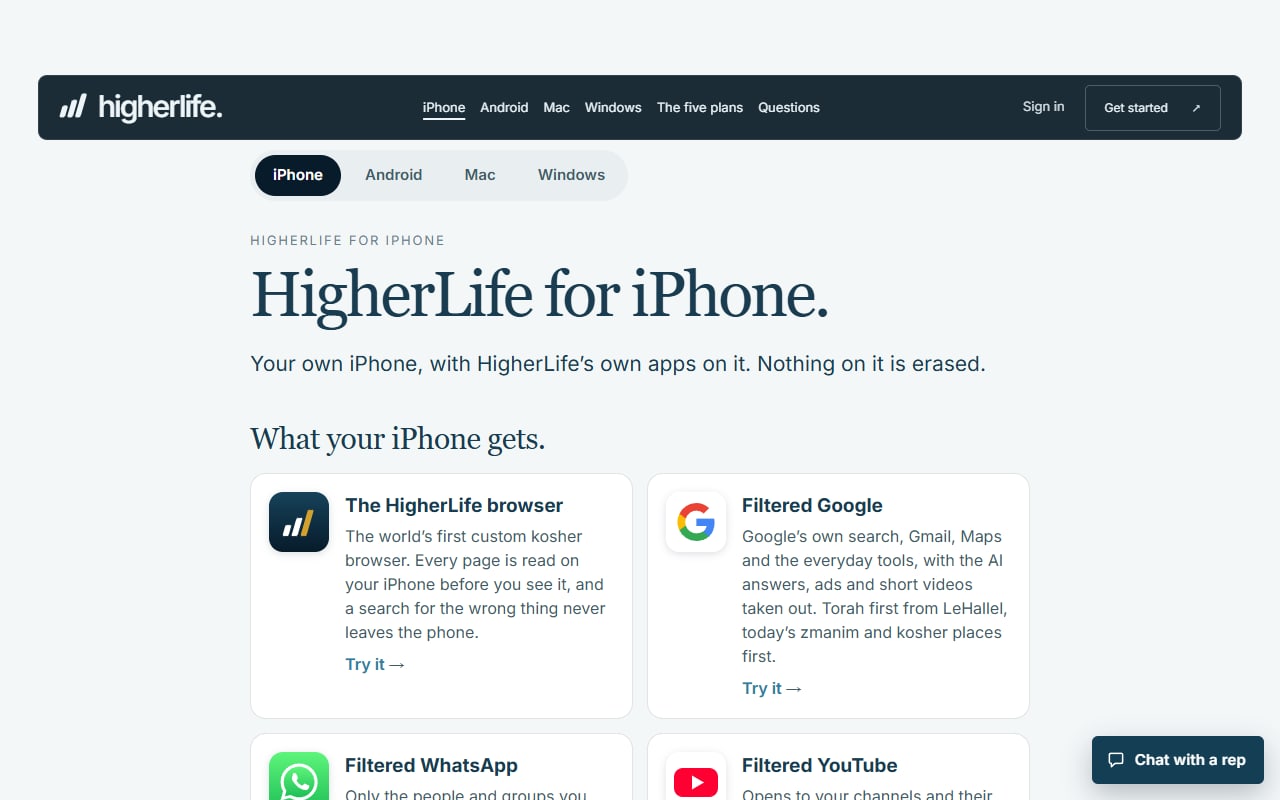
What tends to end a protected phone is not the thing kept out. It is the thing he needed and could not reach. So on iPhone, HigherLife built its own apps for the ones a bochur is most likely to ask about:
- Filtered WhatsApp. Only the people and groups you approve. No Status, Channels or Communities, pictures shaded, and closed for Shabbos if you choose.
- Filtered YouTube. Opens to your channels and their newest videos. Block a channel or a word in a title, and turn comments, live chat and search on or off.
- Google, Gmail and Maps. Google's own search, Gmail, Maps and the everyday tools, with the AI answers and short videos taken out, and today's zmanim and kosher places first.
Torah comes first. LeHallel is there for him, with kosher videos, shiurim and a whole library of sefarim.
Summarize is built in with Claude in the HigherLife browser: press it on a long page and it comes back in a few short, clear lines, and Save keeps them. People in pictures are shaded, the way you choose in My HigherLife. Other well-known browsers do not open.
All of this is on iPhone. On Android today, HigherLife is the HigherLife browser, with every page checked and pictures shaded, and nothing more.
Deciding with him, not for him
A bochur in beis medrash is nearly an adult, and some are adults. A phone decision made over his head tends to last until he is somewhere nobody is watching. A decision he helped make has a better chance.
It helps to say out loud what each side is worried about. A father may worry about what the phone opens. A bochur may worry about looking odd next to his friends, about losing the group chat, or, a few years on, about how a phone looks in shidduchim. Families tell us that last one cuts both ways: some worry that a smartphone hurts, others that no WhatsApp does. Those are questions for the people who know your family, not for a phone company.
Then agree on the plain things: who manages the account, what changes at bein hazmanim, and what happens when something he needs is blocked. Our guide to trust and phones walks through that conversation.
One of the largest gatherings the community has held framed the goal this way. When tens of thousands of men filled Citi Field in 2012 for a gathering on the internet, a spokesman told the Associated Press that "the rally's purpose was not to ban the Internet but to learn how to harness it." Families still differ on where that line sits. For the halachic questions, ask your rav.
The yeshiva phone decision table
Find the line that matches what the yeshiva told you, and start there.
| If the yeshiva says | What it means | Your next step |
|---|---|---|
| Only one named phone | The yeshiva has made the choice. | Buy that phone for the zman. What he carries at home is a separate family decision. |
| Bring the phone for approval | Someone will look at the actual phone. | Ask what they look for, and bring the phone set up the way he will use it, before the zman starts. |
| No phones during the zman | The phone stays home or with the yeshiva. | Set a time for calls home through the yeshiva. The phone is for bein hazmanim and travel. |
| A kosher phone, no name given | No open internet; the choice is yours. | Ask, before buying, whether a protected smartphone counts. |
| Smartphones are fine if protected | The yeshiva trusts the family to choose. | Choose for the hard hours: the dorm at night, the trip, bein hazmanim. |
| Nothing in writing | The rule lives with the mashgiach. | Ask him directly and write down the answer. |
| A yeshiva in Israel | It may want a local approved line. | Ask the yeshiva and your carrier before the flight. |
| Bein hazmanim at home | Your family's rules, unless the yeshiva says otherwise. | Decide together what changes at home, before the first night back. |
iPhone or Android for a bochur
If the yeshiva allows a smartphone, the next question is which one. HigherLife works on both, and they are not the same today.
- iPhone. The HigherLife browser with every page checked and pictures shaded, plus Filtered WhatsApp, Filtered YouTube, Summarize with Claude and HigherLife Guardian. An iPhone is ordered online and set up at home, or set up in person by a HigherLife rep while you wait.
- Android. The HigherLife browser, with every page checked and pictures shaded, and nothing more. An Android is ordered online and set up at home from a computer, with the phone's cable.
For a bochur who needs his shiur's group or a maggid shiur's channel, the iPhone is the one that offers them. For a bochur whose yeshiva wants as little as possible on the phone, an Android with only the browser may be closer to what the yeshiva asks. Either way, show the yeshiva the phone.
The price is the same on both, and on every plan: $80 for six months or $160 for a year, per phone, paid up front by card or cash, with no setup fee. Six months fits one zman and the bein hazmanim after it.
Questions people ask
What phone do yeshivos allow for bochurim?
Each yeshiva sets its own rule. Some name one approved device, some approve the phone a bochur brings, some want no phone during the zman, and some accept a protected smartphone. Ask the yeshiva for its policy in writing before you buy.
Is a HigherLife phone yeshiva approved?
We never claim that. HigherLife is not a hechsher, and a HigherLife phone carries no stamp. If the yeshiva approves phones one by one, bring the phone and let the yeshiva decide. If it names a device, follow the yeshiva.
Should a bochur have a flip phone or a kosher smartphone?
It depends on the yeshiva, the bochur and where he will be. A flip phone is simple and easy to explain; a protected smartphone keeps directions, rides and the groups he needs. Start with the yeshiva's rule, then decide together with him.
Will his American phone work in a yeshiva in Israel?
That is two questions. Whether it works there at all is a question for your carrier, before the flight. Whether the yeshiva accepts it is a question for the yeshiva. In Israel, kosher lines are a community matter, and a yeshiva may want a local line.
Can a bochur keep WhatsApp for his shiur group?
On an iPhone with HigherLife, Filtered WhatsApp shows only the people and groups you approve, with no Status, Channels or Communities, pictures shaded, and closed for Shabbos if you choose. It is on iPhone only. Ask the yeshiva whether it allows it.
Can I change his phone between the zman and bein hazmanim?
Yes. From My HigherLife you can change a phone's level any time, so the same phone can do less during the zman and more at home, as long as the yeshiva's rules allow it.
How much does it cost?
$80 for six months or $160 for a year, per phone, paid up front by card or cash, with no setup fee. The price is the same on every plan, on iPhone and on Android.
Is a smartphone permitted for a bochur at all?
Communities and rabbanim have answered this very differently, from no phone during the zman to a protected smartphone, and many yeshivos make the rule for their own talmidim. Follow the yeshiva, and for the halacha, ask your rav.
Sources
- JTA, Hasidic village makes parents choose: children's education or smartphone, August 5, 2015.
- The Jewish Link, Yeshiva high schools' mobile phone policy, 2022-2023, September 2022.
- Engadget, Israel's kosher phone, March 7, 2005.
- The Times of Israel, MKs pass bill cementing Haredi control over community's kosher phones, July 25, 2024.
- The Jerusalem Post, Report on blocked kosher-phone numbers, quoting an Israeli carrier, February 23, 2026.
- Associated Press via NBC News, Ultra-Orthodox Jews hold rally at Citi Field on the dangers of the internet, May 21, 2012.
- Common Sense Media, Constant Companion: A Week in the Life of a Young Person's Smartphone Use, September 26, 2023.
- University of Texas at Austin, The mere presence of your smartphone reduces brain power, June 26, 2017 (Ward, Duke, Gneezy and Bos).
- Parry, meta-analysis of smartphone presence and cognitive function, Media Psychology, 2023.
- Stothart, Mitchum and Yehnert, The attentional cost of receiving a cell phone notification, Journal of Experimental Psychology: Human Perception and Performance, 2015.